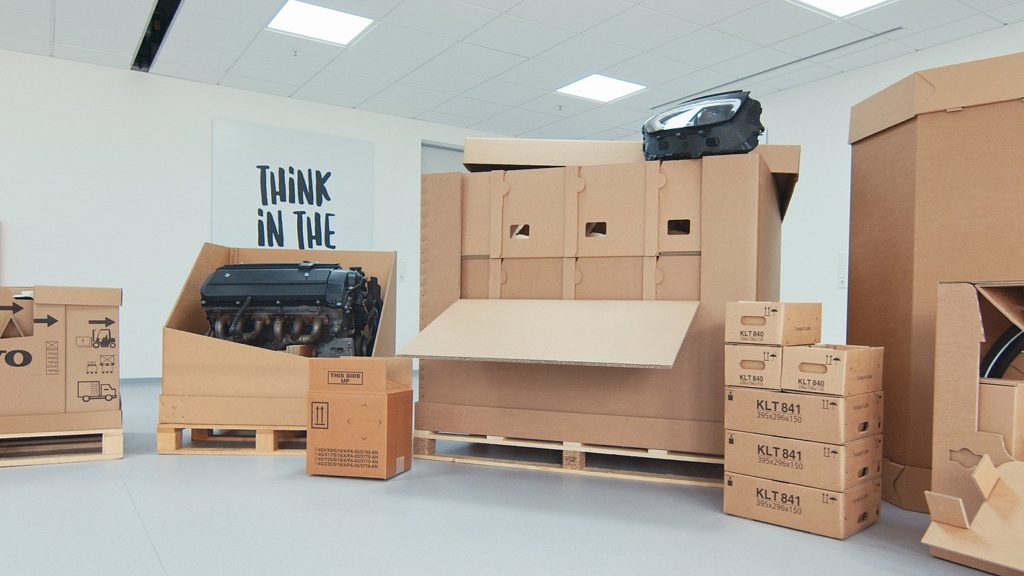
The Octabin is a solution widely used for transporting and storing bulk products, particularly in industrial environments where logistics efficiency, load capacity and structural strength are critical factors. Despite its apparent simplicity, its performance results from a rigorous combination of its anatomy and manufacturing process.
Understanding how an Octabin is constructed helps explain why this solution remains one of the most widely used in industrial logistics.
1. Anatomy of an Octabin
The structure of an Octabin is based on three main components: the base, the body (sleeve) and the lid. Each of these elements plays a specific role in the overall stability and strength of the packaging.
1.1 Base
The base is responsible for supporting the entire load and ensuring stability during transport and storage. In industrial applications, the Octabin is commonly assembled on a pallet, making it easier to move using equipment such as forklift trucks and automated systems.
Alternatively, a reinforced cardboard base may be used, designed to distribute the weight evenly and prevent structural deformation.
1.2 Body
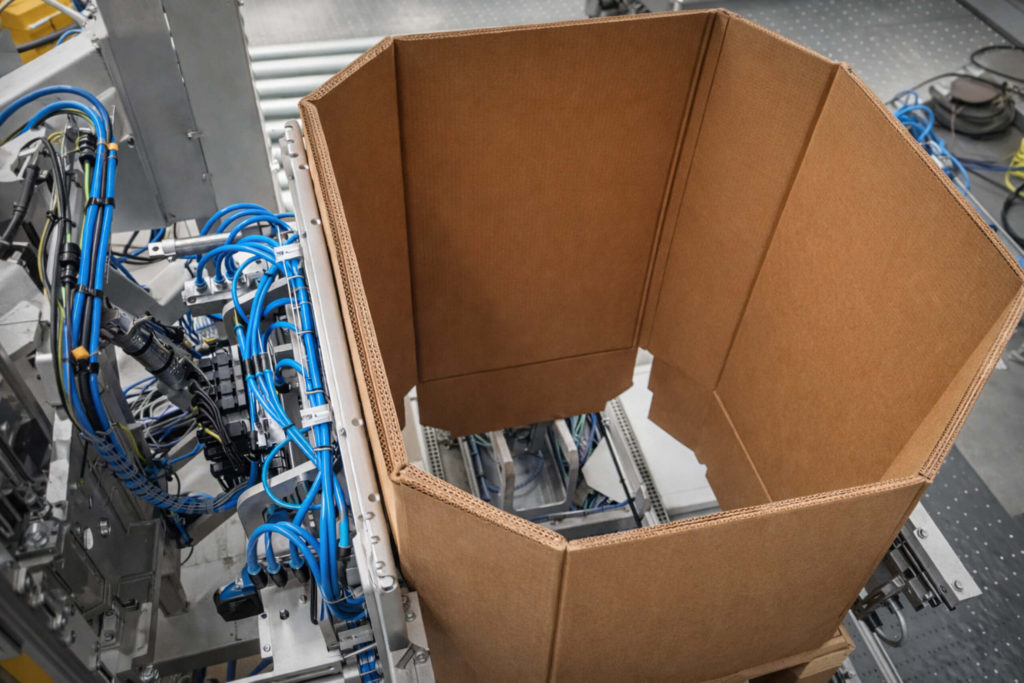
The body of the Octabin is the central element of its structure and the component that defines its volumetric capacity and strength. It is manufactured from high-strength corrugated cardboard, often in double- or triple-wall configurations, depending on the requirements of the application.
The octagonal shape is not arbitrary. This geometry distributes the forces exerted by the load more effectively, increasing compression resistance and improving the performance of the packaging when stacked. In addition, the continuous structure of the Octabin body reduces weak points, contributing to greater structural integrity.
1.3 Lid
The main purpose of the lid is to protect the contents and ensure load stability during stacking and transport. It must be designed according to the same structural principles as the base, ensuring a suitable and uniform closure.
Together with the body, it contributes to the overall rigidity of the packaging and protection against external agents.
2. Manufacturing and assembly process
The performance of an Octabin depends not only on its structural design, but also on the industrial process through which it is produced and assembled.
2.1 Cutting and creasing
The process begins with the cutting and creasing of the corrugated cardboard. At this stage, the material is transformed into a flat piece with the required shape, including all the fold lines needed to form the octagonal structure.
This process is critical because the precision of the cutting and creasing directly influences the quality of the assembly and the structural behaviour of the packaging.
2.2 Forming the body
After cutting, the cardboard is introduced into an assembly line where it is folded and closed to form the octagonal body. This process may be carried out manually or using automated systems known as “erecting systems”, which ensure greater consistency and production efficiency.
During this stage, the correct formation of the edges and the uniformity of the structure are essential to ensure the strength of the packaging.
2.3 Positioning on the base
The body is then placed on the base or pallet. This step ensures that the structure is correctly aligned and ready to receive the load.
Incorrect positioning at this stage can compromise the overall stability of the packaging, particularly during stacking operations.
2.4 Filling
Depending on the application, the Octabin may be used with or without an internal liner. In many cases, particularly when transporting bulk materials, a plastic internal liner is used to protect the product and prevent contamination.
Filling is carried out in a controlled manner to ensure even distribution of the load.
2.5 Closing
After filling, the lid is fitted, completing the structure. This step is essential to protect the contents and allow safe stacking during storage and transport.
Maximising protection and efficiency
The Octabin is an example of how an apparently simple solution can incorporate principles of structural engineering and industrial efficiency. The combination of material, geometry and manufacturing process makes it possible to create packaging capable of meeting complex logistics requirements.
By understanding its anatomy and construction process, it becomes clear that its performance is not the result of a single factor, but rather the integration of several technical decisions throughout the entire production process.