Packaging only truly fulfils its purpose when it can withstand the real conditions of the logistics chain. From the moment it leaves the production line until it reaches the end customer, packaging is exposed to impacts, constant vibration, prolonged stacking and repeated handling. Ignoring these factors during packaging design is one of the main causes of damage, returns and hidden logistics costs.
This is where packaging tests come in. More than a technical validation, testing is a strategic tool that makes it possible to optimise the design, reduce risk and ensure that the packaging is prepared for the realities of transport.
In this article, we explain the main drop, vibration and compression tests and why they are essential when developing effective packaging solutions.
1. Drop Test
The drop test simulates the impacts that packaging may experience during handling throughout the logistics chain.
During transport and distribution, packages may be dropped:
- During loading and unloading
- During manual transfers
- At distribution centres
- During the last mile, particularly in e-commerce
This test makes it possible to assess:
- The structural strength of the packaging
- Its impact absorption capacity
- The effectiveness of the internal protection
- Weak points in the design
Fragile products, technical equipment and high-value items benefit particularly from this type of validation. A small adjustment to the structure or internal reinforcements can make a significant difference to the final result.
2. Vibration Test
During road, rail or sea transport, packaging is exposed to constant vibration for long periods.
Although these vibrations may appear harmless, their cumulative effect can cause:
- Internal movement of the product
- Premature wear of the packaging
- Microdamage that only becomes apparent at the final destination
The vibration test makes it possible to:
- Simulate real transport conditions
- Assess the stability of the product inside the packaging
- Validate the need for dividers, reinforcements or additional cushioning
This test is particularly important for technical products, industrial components and goods transported over long distances.
3. Compression Test
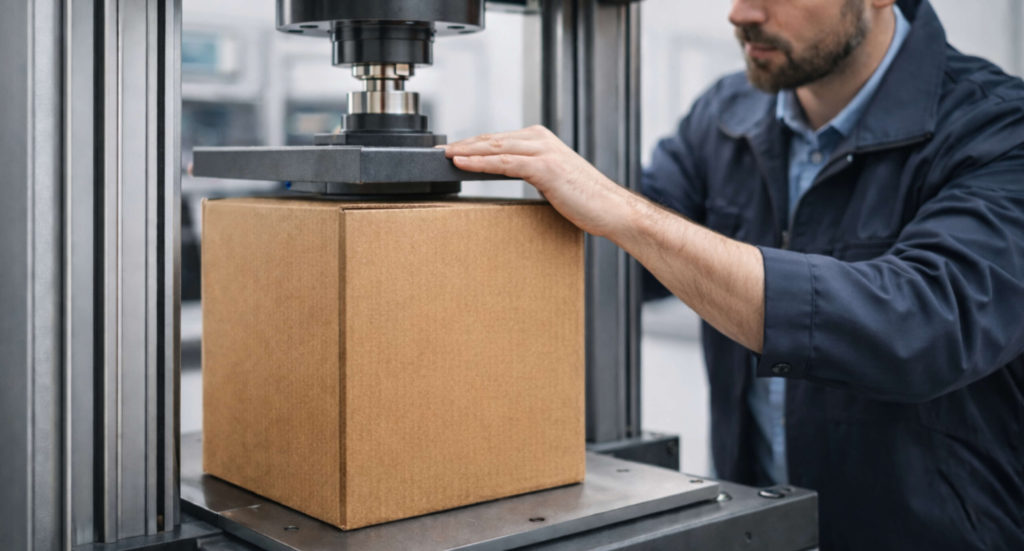
The compression test assesses the packaging’s resistance to the vertical pressure exerted during stacking.
In warehouses and during pallet transport, packaging may be subjected to high loads for extended periods. If the packaging is not correctly dimensioned, this can result in:
- Deformation
- Structural collapse
- Product damage
- Load instability
This test makes it possible to:
- Determine the maximum strength of the packaging
- Assess the most suitable type of cardboard
- Ensure safety during storage and transport
It is essential for industrial packaging, heavy loads and Heavy Duty solutions.
4. Combined Tests
In reality, packaging is rarely subjected to only one type of stress.
Impacts, vibration and compression occur together throughout the logistics cycle.
Combined tests make it possible to:
- Reproduce real transport scenarios
- Assess the overall behaviour of the packaging
- Adjust the structural design more precisely
- Reduce risk before large-scale production
This approach is fundamental for technical and customised packaging.
5. Direct Benefits of Packaging Tests
Investing in testing during the design phase brings clear benefits for companies:
- Reduced damage and returns
- Lower logistics and operating costs
- Greater efficiency in transport and storage
- Better product protection
- Greater confidence throughout the supply chain
Testing is not an additional cost; it is a way to prevent much greater losses in the future.
Conclusion
Effective packaging design begins with engineering and validation, not merely aesthetics or immediate cost.
Drop, vibration and compression tests make it possible to transform ordinary packaging into a reliable and efficient solution prepared for real logistics conditions.
👉 At Verpakking, we develop cardboard packaging solutions designed, tested and adjusted to the real requirements of each product and industry.