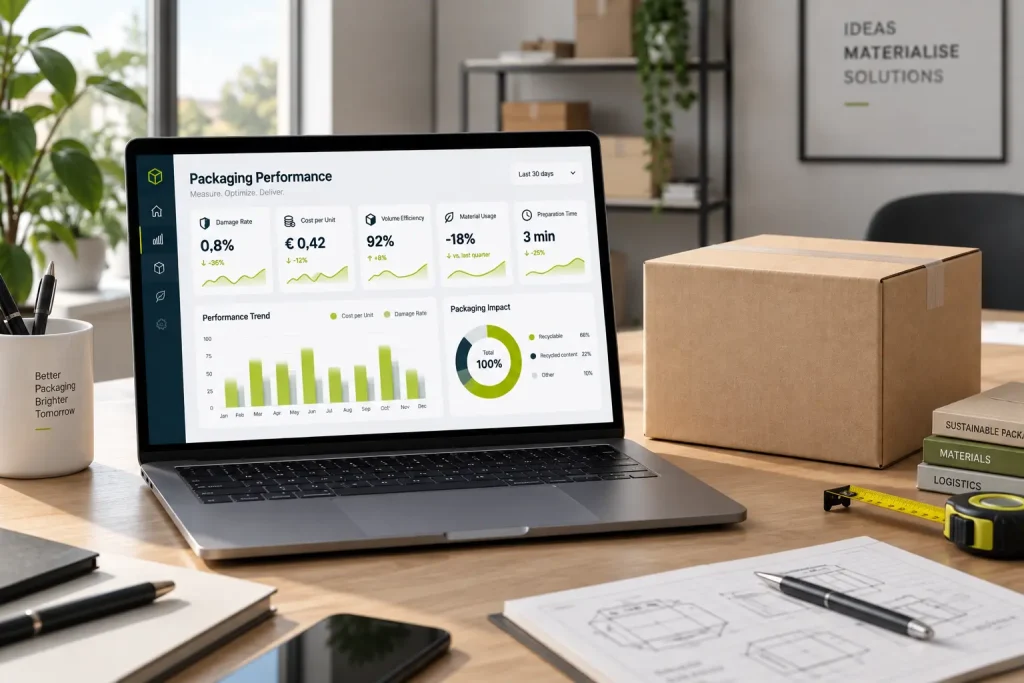
Packaging may appear suitable, meet the required dimensions and protect the product at first glance. But is it really performing as it should?
The answer doesn’t always lie in the packaging itself.
It also lies in the space it occupies during transport, the amount of material used, the time required to prepare each order, the products that arrive damaged at their destination and the costs that accumulate throughout the operation.
This is why evaluating a packaging solution based solely on its price can provide an incomplete picture of its true performance.
Packaging cost is only part of the equation
Imagine two packaging solutions for the same product.
The first has a lower unit cost but requires more protective filling, takes up more space and takes longer to prepare.
The second has been specifically designed to fit the product. It may have a slightly higher unit cost, but it reduces empty space, simplifies packing and allows more units to be transported within the same volume.
Which solution is actually more cost-effective?
To answer this question, we need to look beyond the price of the box.
Damage is one of the clearest performance indicators
One of the first signs that packaging may not be performing its intended function is the frequent occurrence of damaged products.
And the impact of a damaged product rarely ends with the product itself.
It may result in a return, a replacement shipment, additional processing time, customer communication and, in some cases, a loss of trust in the brand.
Monitoring the number of incidents involving transport damage helps determine whether the packaging provides adequate protection under real operating conditions.
How much space are we really transporting?
Empty space also comes at a cost.
Packaging that is significantly larger than the product may require additional protective filling and occupy more space during storage and transport.
When this difference is multiplied across hundreds or thousands of units, even a few centimetres can make a significant difference.
Correct packaging dimensions can therefore have a direct impact on logistics efficiency.
Enough material doesn’t mean excessive material
Adding more protection may seem like the safest solution.
But that isn’t always the case.
The aim should be to use the amount of material necessary to provide the level of protection the product requires, while avoiding unnecessary waste.
Cardboard, foam, dividers, protective profiles and other packaging components should be included because they serve a specific purpose within the overall solution.
And how long does it take to prepare each package?
There is another metric that is often overlooked: time.
Folding, assembling, adding protective materials, positioning the product, filling empty spaces and sealing the package are tasks performed repeatedly throughout the day.
Even a small simplification in this process can make a significant difference when applied across an entire production operation.
An effective packaging solution should not only protect the product but also be simple and efficient for those who handle it every day.
Measure to improve
There is no single metric that can determine whether a packaging solution is efficient.
It is the combination of several indicators that provides a clear understanding of its true performance.
Costs, damage rates, material usage, space optimisation, transport and packing time are all part of the same equation.
At Verpakking, we assess each project by considering not only the packaging itself, but also the product and the environment in which it will be used.
Because efficient packaging isn’t necessarily the cheapest option. It’s the solution that delivers the best overall operational performance.